
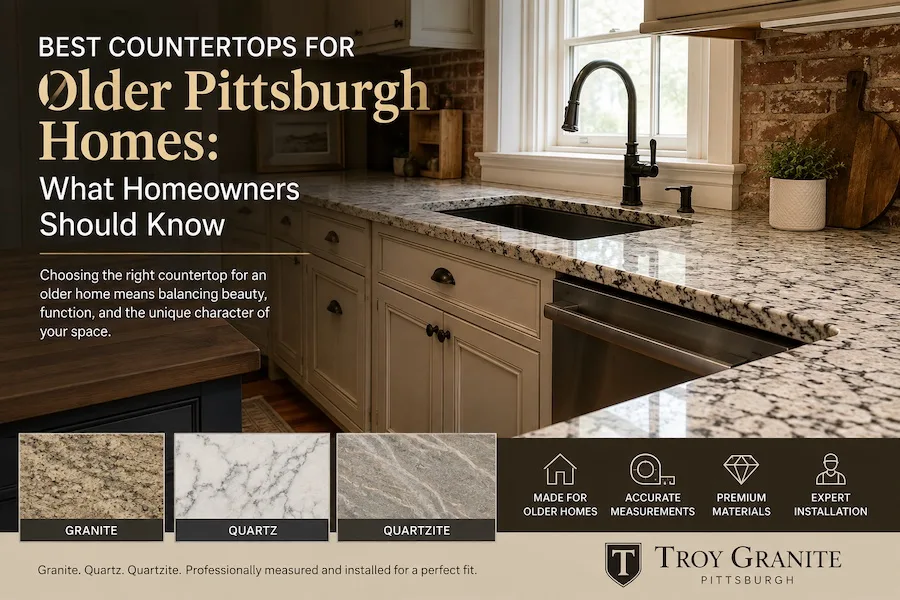
Older Pittsburgh homes have a character that newer construction often cannot replicate. From classic brick exteriors and original woodwork to traditional kitchen layouts, many homes throughout the Pittsburgh area were built with details and materials designed to last for generations.
But renovating an older home can also come with challenges—especially in the kitchen.
If your cabinets are still in good condition but your countertops are outdated, damaged, or simply no longer fit the style of your home, replacing the countertops can be an effective way to update the kitchen without taking on a complete remodel.
However, choosing the right countertop for an older Pittsburgh home requires more than picking a color you like. The condition of the cabinets, the layout of the kitchen, the installation process, and the overall character of the house should all be considered.
Here is what Pittsburgh homeowners should know before choosing new countertops for an older home.
Why Older Pittsburgh Homes Require a Different Approach
One of the biggest differences between older homes and newer construction is that no two kitchens are necessarily alike.
Older homes may have cabinets that are no longer perfectly level, walls that are slightly out of square, or kitchen layouts that were built around the original architecture of the house. Years of settling and previous renovations can also affect measurements.
This does not necessarily mean that an older kitchen needs to be completely rebuilt.
In many cases, homeowners can keep existing cabinets and install new countertops. But accurate measurements and professional installation become particularly important when working with an older kitchen.
A countertop that looks perfect in a showroom still needs to fit the actual kitchen.
Granite Countertops: A Strong Choice for Traditional Kitchens
Granite remains one of the most popular choices for homeowners who want a durable, natural-stone countertop.
For older Pittsburgh homes, granite has another advantage: it can complement traditional architecture without making the kitchen look overly modern.
Natural variation in granite can work particularly well with:
- Wood cabinets
- Traditional cabinetry
- Brick accents
- Warm flooring
- Classic kitchen designs
- Transitional renovations
Granite is also highly durable and can handle the everyday demands of a busy kitchen. With proper care, a quality granite countertop can remain attractive for many years.
Another benefit is the variety of available colors and patterns. Homeowners can choose something subtle that blends into an existing kitchen or select a more dramatic stone that becomes the focal point of the renovation.
For homeowners who want to preserve the traditional character of an older Pittsburgh home while improving the kitchen, granite is often worth considering.
Quartz Countertops for a Cleaner, More Modern Look
Quartz is another excellent option, particularly for homeowners who want a more consistent appearance.
Unlike natural stone, engineered quartz is manufactured using a controlled process. This allows manufacturers to create slabs with relatively consistent colors and patterns.
That can be useful when renovating an older kitchen that already has several visual elements.
For example, if your kitchen has original wood cabinets, older flooring, or decorative architectural details, a simple quartz countertop can provide a cleaner surface without competing with those features.
Quartz can also be a practical choice for homeowners who prefer a low-maintenance countertop and do not want to spend as much time thinking about stone maintenance.
The right choice ultimately depends on the kitchen and the homeowner’s priorities. Granite offers the natural variation and character of stone, while quartz provides consistency and a broad range of contemporary styles.
What About Quartzite?
Quartzite is another natural stone option that deserves consideration.
Although the names are similar, quartzite and quartz are different materials. Quartzite is a naturally occurring stone that is quarried and fabricated into countertops, while quartz countertops are engineered products.
Quartzite can offer the appearance of high-end natural stone while providing excellent durability.
For an older Pittsburgh home undergoing a more substantial kitchen renovation, quartzite can be an attractive choice when the homeowner wants the countertop itself to become a major design feature.
Because natural quartzite slabs can vary significantly in appearance, homeowners should take the time to view the actual slab before making a final selection.
Can You Keep Your Existing Cabinets?
One of the most important questions when replacing countertops in an older home is whether the existing cabinets need to be replaced.
The answer is often no.
If the cabinets are structurally sound, replacing the countertop may provide a significant visual improvement without the cost and disruption of replacing the entire kitchen.
This can be particularly appealing in older Pittsburgh homes where the existing cabinetry contributes to the character of the kitchen.
Before making a decision, however, homeowners should evaluate the condition of the cabinets.
Look for signs of:
- Water damage
- Swollen or deteriorating cabinet material
- Loose doors or hinges
- Significant structural damage
- Cabinets that are no longer securely attached
- Severe unevenness or instability
If the cabinets are in good condition, a new granite, quartz, or quartzite countertop may be all that is needed to give the kitchen a completely different appearance.
Accurate Measurements Matter Even More in Older Kitchens
Countertop installation is not simply a matter of cutting a slab to a standard size.
Older homes can present unique measurement challenges.
Walls may not be perfectly straight. Cabinets may have been modified over the years. Appliances may have been replaced with models of different dimensions. Sinks and cooktops may also have been changed during previous renovations.
That is why professional measurement is an important part of the countertop replacement process.
Before fabrication begins, the countertop needs to be measured based on the actual dimensions and conditions of the kitchen.
A small measurement error can create significant problems during installation.
For homeowners renovating an older property, professional measurement can help identify potential issues before the countertop is fabricated rather than after it arrives at the house.
Choosing the Right Countertop Color
The best countertop for an older Pittsburgh home is not necessarily the most modern-looking option.
Think about the existing elements in the kitchen.
If you have warm wood cabinets, a natural granite with warm or neutral tones may create a cohesive appearance. If the kitchen has white or painted cabinets, a more contrasting stone can add visual interest.
For a kitchen with dark cabinetry, lighter countertops can help brighten the room. Meanwhile, homeowners with a predominantly white kitchen may prefer a countertop with more movement and natural variation.
It is also worth considering the surrounding rooms.
Older Pittsburgh homes often have kitchens that connect directly to dining rooms, living areas, or other parts of the house. The countertop should therefore work with the home’s overall interior rather than looking like an isolated modern addition.
Traditional, Transitional, or Modern?
Before selecting a countertop, determine the design direction of the renovation.
A traditional kitchen may benefit from a natural granite with visible variation and warmer tones.
A transitional kitchen gives homeowners more flexibility. Both granite and quartz can work well, depending on the cabinets, backsplash, flooring, and hardware.
A modern renovation may lean toward quartz with a cleaner pattern and simpler visual appearance.
There is no single countertop that is universally best for every older home.
The goal is to find a material that improves the kitchen while still making sense within the architecture and style of the property.
Don’t Choose a Countertop Based on Price Alone
Price is obviously an important part of any kitchen renovation, but the lowest initial price is not always the best value.
Homeowners should understand what is included in a countertop quote.
Depending on the project, costs may involve:
- The countertop material
- Measuring
- Fabrication
- Edge profile
- Sink cutouts
- Cooktop cutouts
- Removal of existing countertops
- Installation
- Additional modifications
Comparing quotes based only on the price per square foot can therefore be misleading.
Two countertop estimates may appear very different because they include different services or fabrication details.
Ask what is included before making a decision.
A Countertop Upgrade Can Transform an Older Kitchen
One of the biggest advantages of replacing countertops instead of remodeling the entire kitchen is the potential impact of a relatively focused renovation.
A new countertop can change the appearance of the kitchen dramatically.
It can make older cabinets look more current, provide a new focal point, improve the workspace, and help connect different elements of the room.
And because the countertop is one of the most visible surfaces in a kitchen, choosing the right material can have an impact far beyond its practical function.
For many Pittsburgh homeowners, the best renovation is not necessarily one that removes everything that makes an older house unique. It may be one that preserves the good parts while updating the elements that have become worn or outdated.
Planning a Countertop Upgrade in Your Pittsburgh Home?
If you’re considering new countertops for an older Pittsburgh home, the best place to start is with an evaluation of your existing kitchen. You may not need to replace your cabinets or completely remodel the space to achieve a significant transformation.
At Troy Granite Pittsburgh, homeowners can explore granite, quartz, and other countertop options based on their kitchen’s layout, existing cabinetry, style, and budget. Professional measurements and fabrication can also help ensure that the new countertop is properly suited to the unique dimensions of an older kitchen.
Whether you’re updating a traditional Pittsburgh home or giving an older kitchen a more modern look, choosing the right countertop starts with seeing your options and understanding what the project will involve.
Ready to explore your options? Contact Troy Granite Pittsburgh for a free estimate and find the right countertop for your home.
Final Thoughts for Pittsburgh Homeowners
Older Pittsburgh homes deserve a countertop that works with the home rather than against it.
Granite, quartz, and quartzite can all be excellent choices, but the right material depends on your existing cabinets, design preferences, maintenance expectations, budget, and the condition of the kitchen itself.
If your cabinets are still structurally sound, you may not need a complete kitchen renovation. Replacing the countertops can provide a significant upgrade while allowing you to preserve much of the existing character of the home.
The most important step is to evaluate the kitchen before choosing the stone.
Consider the condition of the cabinets, verify the measurements, think about the overall design of the house, and make sure you understand what is included in the installation quote.
A well-planned countertop replacement can give an older Pittsburgh kitchen a fresh new look while preserving the character that made the home worth renovating in the first place.
Recent Comments